Rui Zhang

I study atmospheric and climate dynamics using both idealized and comprehensive models.
Research
Impact of latent heating on baroclinic wave activity
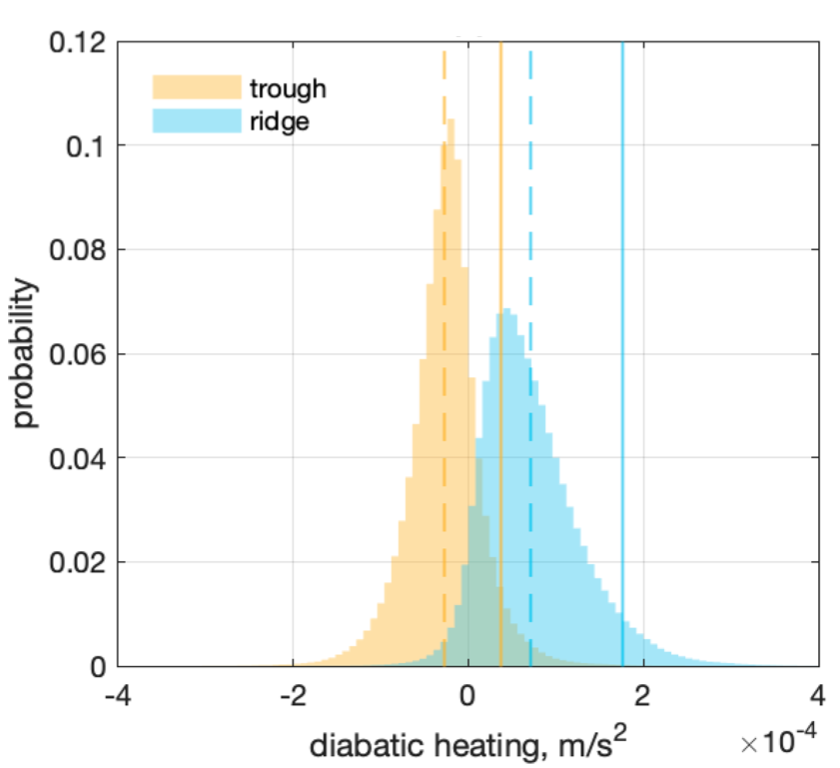
Using a moist two-layer quasi-geostrophic model and the local finite-amplitude wave activity (LWA) framework, we identify a twofold effect of latent heating on baroclinic waves. (a) For the mean state, the direct diabatic source of LWA is positive, yet the total generation (baroclinic plus diabatic) is reduced relative to the dry case, because precipitation weakens the mean-state baroclinicity and hence the baroclinic source. Consequently, by zonal-mean metrics, eddies are weaker in the moist model than in the dry model under the same radiative forcing. (b) For individual wave phases, latent heating can dominate the growth of upper-layer ridges, through the generation of negative potential vorticity, but not that of troughs.
Zhang, R., and E.K.M. Chang, 2025: Using finite amplitude wave activity to examine the impact of latent heating on baroclinic wave activity. Journal of the Atmospheric Sciences, 82, 1929-1951.
Downstream development of Rossby waves
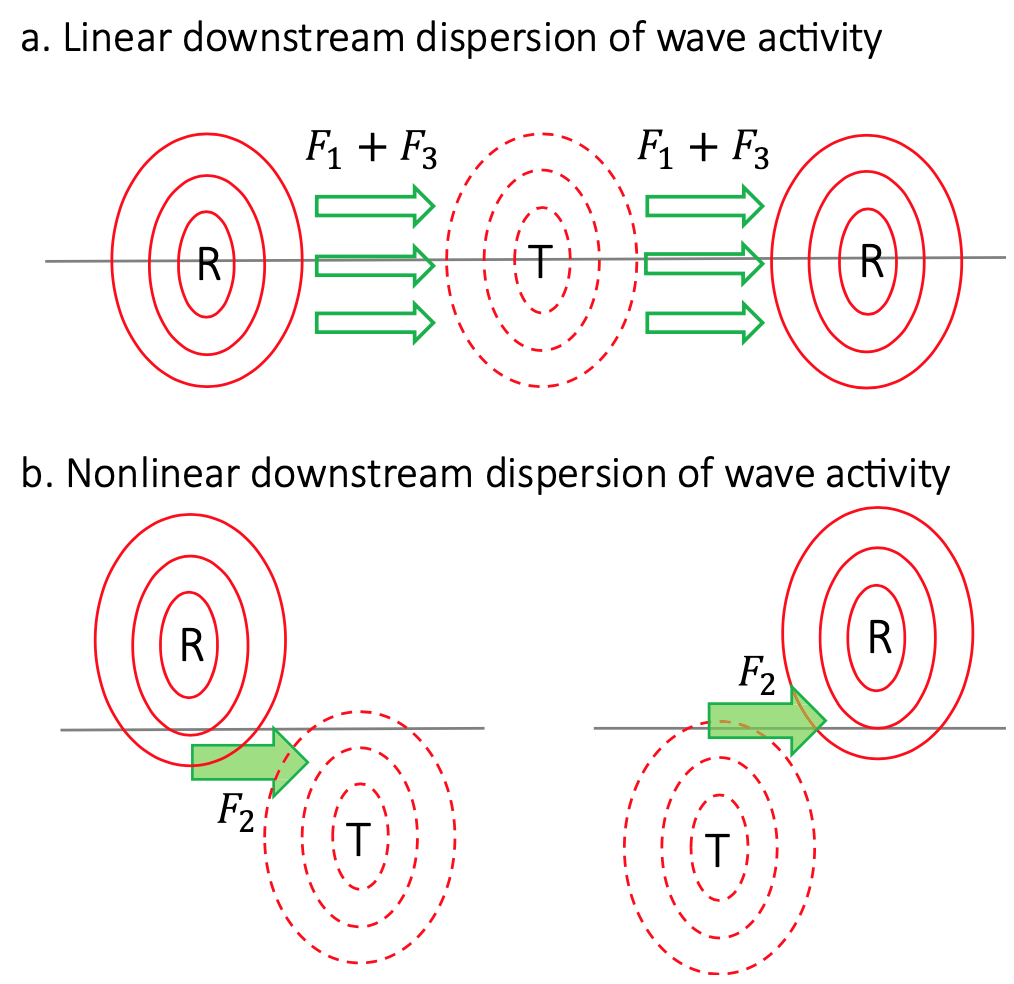
We use the local finite-amplitude wave activity (LWA) budget, a conservative alternative to the eddy-kinetic-energy budget, to examine the downstream development of Rossby waves through the life cycles of troughs within a coherent wave packet. Individual troughs grow and decay both through linear downstream development, in which advection by the reference flow and the radiation stress of Rossby waves disperse wave activity downstream, and through a nonlinear dispersion of wave activity, in which convergence or divergence of the nonlinear advective LWA flux transfers wave activity between a trough and its neighboring ridges. Linear downstream development dominates for small-amplitude, near-sinusoidal waves, whereas nonlinear dispersion takes over once troughs and ridges reach large amplitude with complex, meridionally displaced structure.
Zhang, R., E.K.M. Chang, and N. Nakamura, 2025: Wave packets and life cycles of troughs in the framework of local finite-amplitude wave activity. Journal of the Atmospheric Sciences, 82, 789-808.
Local finite-amplitude wave activity of water vapor
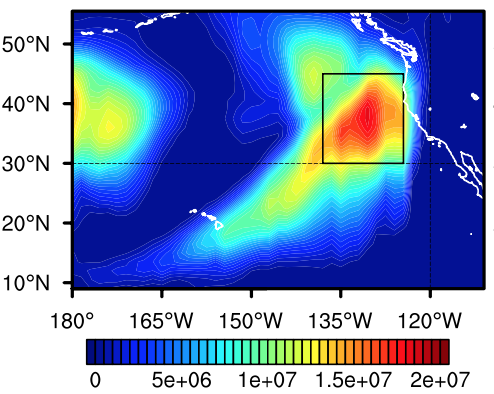
We generalize the local finite-amplitude wave activity (LWA) framework from quasi-geostrophic potential vorticity to total column water vapor, defining a hybrid Eulerian–Lagrangian diagnostic, LWA-V, and deriving its budget equation. LWA-V measures the meridional displacement of moisture contours from their zonally symmetric reference state and captures the filamentary structure and poleward moisture intrusion of atmospheric river (AR) events. Its budget is more directly interpretable than the traditional moisture budget: moisture flux convergence acts as the local source and evaporation minus precipitation as the net sink, without the paired convergence and divergence that obscure conventional interpretation. Exploiting the Lagrangian aspect of the diagnostic, we trace the moisture supplying an AR event back to its tropical source latitudes.
Zhang, R., and E.K.M. Chang, 2025: Local finite-amplitude wave activity of water vapor as a diagnostic of atmospheric river events. Geophysical Research Letters, 52(8), e2024GL114314.
Extreme windstorms and model resolution
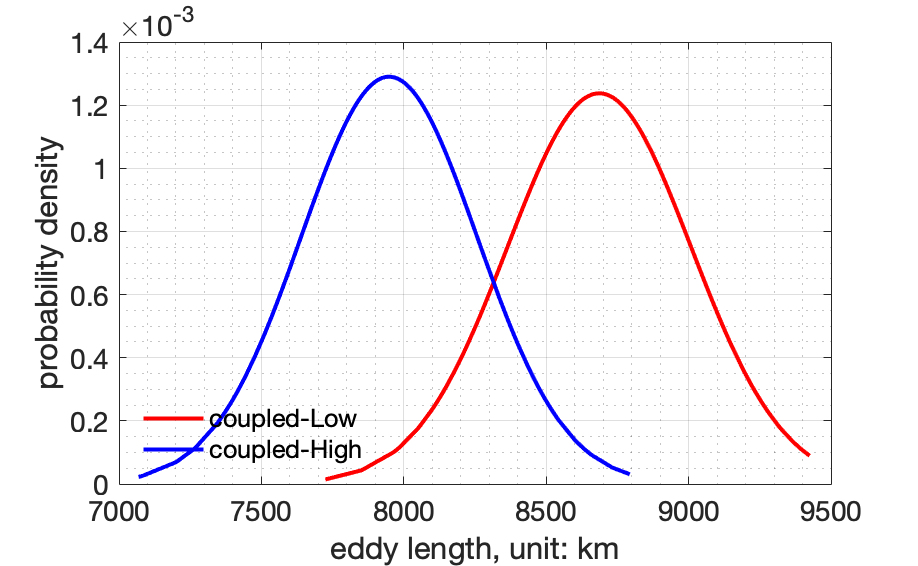
Across a multi-member HighResMIP and regionally downscaled ensemble, we show that model grid spacing strongly shapes simulated extreme windstorms over the northeastern United States and southeastern Canada: coarse-grid-spacing models overestimate windstorm frequency and size, through lower 99th-percentile wind thresholds and an inflated eddy length scale that indicates an overestimated Rossby deformation radius, and they convert available potential energy to eddy kinetic energy less efficiently, failing to capture the most intense cyclones. Despite this sensitivity, the direction of projected change is robust — extreme windstorms become more frequent under warming regardless of grid spacing or coupling strategy, even as overall mid-latitude cyclone numbers decline, because more intense cyclones, including transitioning tropical cyclones, track into the region.
Zhang, R., O. Asselin, D. Paquin, R.J. Barthelmie, and S.C. Pryor, 2026: Projected changes in extreme windstorms and high-wind cyclone tracks across model resolutions. npj Climate and Atmospheric Science, https://doi.org/10.1038/s41612-026-01526-1.